Homemade recipes
How Many Calories Does Cooking Oil Add to Food?
How many calories does cooking oil add to food? About 120 kcal per tablespoon, but only the oil the food absorbs counts. See the math.
Guides
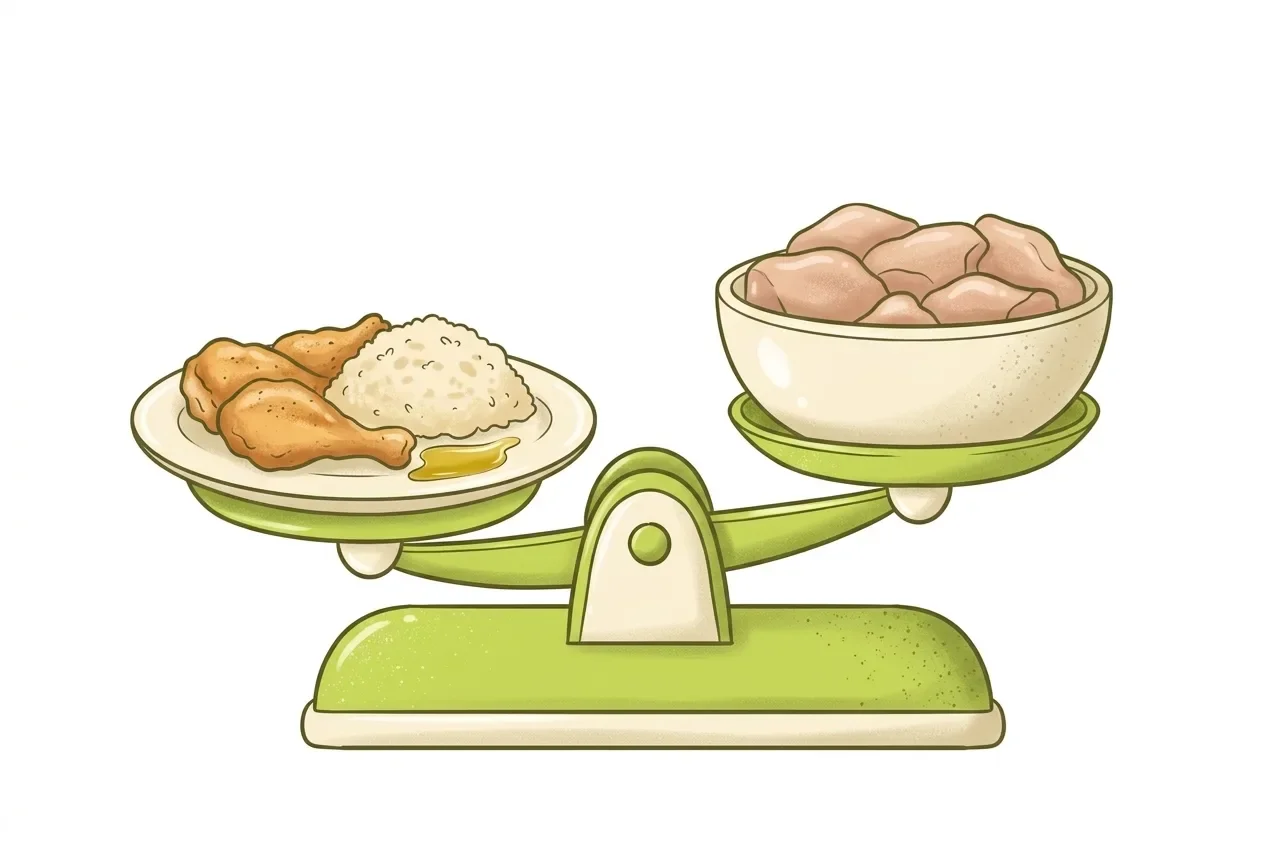
To calculate calories in a recipe, add up the calories of each ingredient from its raw weight, then divide the total by the number of servings or the cooked weight of the portion you eat. This works for any homemade recipe, as long as you weigh consistently and match each ingredient's nutrition data to the state it's actually in when you weigh it. The rest of this guide shows why the obvious shortcut gives the wrong number, then works through a full dinner from raw weights to one plate.
In short
- Raw skinless chicken breast has 120 kcal per 100 g, according to USDA FoodData Central.
- Cooked long-grain white rice has 130 kcal per 100 g, according to USDA FoodData Central, and cooked rice weighs about 280% of its dry weight.
- The worked-example dinner, with chicken, rice, oil and vegetables, totals 1107 kcal, about 277 kcal per serving across four equal servings.
Homemade food doesn't come with its own label. The method below builds one from the ingredients, and you can reproduce it with a kitchen scale and a calculator.
List every ingredient that carries energy: the meat, the rice, the oil, the sauce, even a spoonful of butter. Weigh what actually goes into the pot, not the package weight before you trim or peel it.
For each ingredient, look up the calories per 100 g in a public database such as USDA FoodData Central, or on the ingredient's own label. Matching the exact cut, fat content and raw or cooked state matters more than it first seems.
Calories for one ingredient = grams used × calories per 100 g ÷ 100.
Add the result for every ingredient. That sum is the total calories in the whole dish, before it's divided into whatever anyone actually eats.
If a label shows kilojoules, convert them to kilocalories. Regulation (EU) No 1169/2011 sets what a food label must declare in the European Union, including energy in kJ and kcal per 100 g or 100 ml. Avocalo's own nutrition-label tool uses the standard conversion of 1 kcal = 4.184 kJ, useful for checking a total you calculated by hand.
Weigh and record each ingredient in the state your nutrition source describes, and don't mix the two states. A value for dry rice matches the dry weight you put in the pot, not the swollen weight after it absorbs water.
This matters most with meat. Chicken loses water as it cooks, so 400 g of raw breast no longer weighs 400 g once roasted. If you weigh the cooked chicken but multiply by the raw chicken's calories per 100 g, you inflate the total, because you're counting cooked grams against a raw value that assumes more retained water. The related guide on how cooking method changes chicken's protein shows the same mix-up, for protein instead of calories.
The fix is to pick one point in the process, record the weight at that point, and use a calorie value measured at the same point. Raw weight with a raw value works. Cooked weight with a cooked value works. Mixing the two doesn't. Should You Weigh Food Raw or Cooked? walks through this calculation step by step, with USDA data for several foods.
Long-grain white rice ends up at about 280% of its raw weight after boiling, according to USDA FoodData Central (FDC 168877 for raw rice and FDC 168878 for cooked). That means 100 g of dry rice becomes 280 g of cooked rice, because the grain absorbs water.
Meat goes the other way: it loses water rather than gaining it. Avocalo's own raw-to-cooked weight converter shows USDA-measured yields for several kinds of meat, fish and vegetables, each with its own source.
No single percentage applies to every food. Rice gains weight through water absorption, and meat loses weight through evaporation, opposite directions of the same cooking process.
Here's a dinner calculated from raw ingredient weights through to one serving on a plate. The figures for chicken, rice and oil come from USDA FoodData Central, cited below the table.
The vegetable side and the dish's final weight are illustrative, invented to complete the arithmetic, because no measured figure was available for either.
| Ingredient (state used) | Weight added | kcal per 100 g | Source | Ingredient calories |
|---|---|---|---|---|
| Chicken breast, raw | 400 g | 120 | USDA FDC 171077 | 480 |
| White rice, cooked | 300 g | 130 | USDA FDC 168878 | 390 |
| Olive oil | 20 g | 884 | USDA FDC 171413 | 177 |
| Vegetables (illustrative) | 200 g | 30 | illustrative only | 60 |
| Total | 1107 |
The chicken row is 400 × 120 ÷ 100 = 480 kcal.
The rice row uses the cooked-rice value directly, since 300 g here is the cooked weight: 300 × 130 ÷ 100 = 390 kcal. The oil row is 20 × 884 ÷ 100 = 177 kcal (rounded from 176.8). Adding all four rows gives 480 + 390 + 177 + 60 = 1107 kcal.
Suppose the finished dish weighs 1100 g, an illustrative total. Dividing 1107 by 1100 gives about 101 kcal per 100 g. Split into four equal servings, that's 1107 ÷ 4 = 277 kcal per serving. If you use a different source for any ingredient, redo that multiplication with your own figure.
Count the oil you add to the dish, and think honestly about what gets lost along the way. A tablespoon of olive oil poured into a pan doesn't all end up on the plate. Some stays behind as a film on the pan or gets drained off with excess fat.
This guide has no sourced figure for what percentage of oil a particular dish retains, because it depends on the pan, the heat and the food itself. Record the oil you add as an ingredient, since that's measurable, and treat any adjustment for retained oil as your own estimate, not a cited fact.
If you pour off visible fat or oil after cooking, that energy left with it. Weighing what you discard and subtracting it from your estimated calories is more accurate than guessing a fixed reduction. Avocalo's free cooking-oil calorie calculator does this arithmetic from how much oil went into the pan and how much was left afterward, splitting the rest between servings.
Divide the dish's total calories according to how you split the food. For equal servings, divide the total by the number of servings, as in the 277 kcal example above.
For a weighed portion, divide the total by the cooked weight of the whole dish, then multiply by the weight on the plate: 1107 ÷ 1100 × 350 = 352 kcal for a 350 g serving.
Both methods assume the food is mixed evenly through the dish. A plate with more chicken won't match one with more rice, even at the same weight. For a dish with separate components, calculate each component on its own for a more accurate result.
Avocalo's free recipe-portion calculator does this arithmetic for you. It returns calories per serving, per 100 g, or for a specific portion. You can type in the recipe's total directly, or build the total inside the calculator by adding ingredients from its list of 147 common foods with USDA values, or by typing in the kcal per 100 g from a label.
A meal photo offers a different kind of estimate, not the same calculation done faster. It can identify visible foods and suggest a portion size, but it can't see oil mixed into a sauce or weight hidden below a dish's surface.
Avocalo's photo logging works this way. The user photographs a meal, and an AI vision model estimates the foods, portions, calories and macronutrients from the image. The result is an approximation: it can't account for hidden oil, sauces mixed into a dish, or exact portion size. The user reviews and can edit the result before saving it. The estimate comes from the model reading the image, it isn't matched against a nutrition database, and the app doesn't weigh food.
The ingredient-by-weight method above stays more reproducible, because it's built from values you chose and can check yourself. Download Avocalo if photo logging fits your usual way of eating better.
Look up the ingredient in a public database such as USDA FoodData Central, matching the cut, fat content and raw or cooked state as closely as you can. If no exact match exists, pick the closest entry and treat the result as an estimate, not an exact figure.
The total for the whole pot is the sum calculated from each ingredient, before any dividing happens. Calories per serving come afterward, by dividing that total by the number of servings or by the cooked weight of the portion you eat.
A kitchen scale makes the method far more accurate, because the calories-per-ingredient formula starts from a weight in grams. Without a scale you can estimate with volume measures or typical portion sizes, but the result will be less precise than a weighed figure.
Divide the total calories by whatever number of servings the recipe actually makes, whole number or not. The formula calories per serving = total ÷ number of servings works the same whether that's three servings, five, or a fraction.
Yes, record the edible weight that actually goes into the dish. A value for raw chicken breast already assumes the skin and bone are removed, so weigh the trimmed piece, not the whole cut you bought.
Published by Petros IT Solutions SRL. See our editorial policy for how we source and check our guides, or send a correction to contact@avocalo.app.